What should be in an earthquake kit, and where do you keep it?
You live where the ground can shake, or you are starting to think about it. There is a tall shelf over the bed and a flashlight nobody can find, and you wonder what a kit for this should hold.
Ready.gov asks for a supply kit with food and water for several days, a flashlight, a whistle and a fire extinguisher, and for heavy items to be secured and kept on low shelves. Chile's SENAPRED says 48 to 72 hours, in an easy-to-reach place. Italy's Civil Protection asks you to fix tall furniture to the walls and to know where the gas, water and electricity switches are.
Start with what can fall
Ready.gov asks you to secure heavy items in your home, such as bookcases, refrigerators, water heaters, televisions and objects that hang on walls, and to store heavy and breakable objects on low shelves. Italy’s Civil Protection goes into more detail: move heavy furniture away from beds and sofas, fix shelves, bookcases and other tall furniture to the walls, put heavy objects on the lower shelves, and hang pictures and mirrors with closed hooks. It also suggests a latch on kitchen cabinet doors so they do not open when the ground shakes.
What the pages ask you to keep
The three pages do not give the same list. The main items:
- Food: several days’ worth of non-perishable food (Ready.gov), that can be eaten without cooking (SENAPRED).
- Water: one gallon per person per day (Ready.gov) or two litres per person per day (SENAPRED).
- A flashlight or torch, with batteries or hand-crank (SENAPRED).
- A first aid kit and a battery radio (Italy’s Civil Protection).
- A whistle and a fire extinguisher (Ready.gov).
- Sturdy shoes and a change of clothes (Ready.gov, SENAPRED).
Ready.gov’s kit page also lists a wrench or pliers to turn off utilities. SENAPRED says basic supplies for 48 to 72 hours, and Ready.gov says several days. Each page is longer than this list, and what your home needs depends on who lives in it.
Where to keep it
Ready.gov says to keep the kit in a designated place, ready in case you have to leave your home quickly. SENAPRED asks for an easy-to-reach place, ready to use. Italy’s Civil Protection asks you to make sure everyone at home knows where the items are.
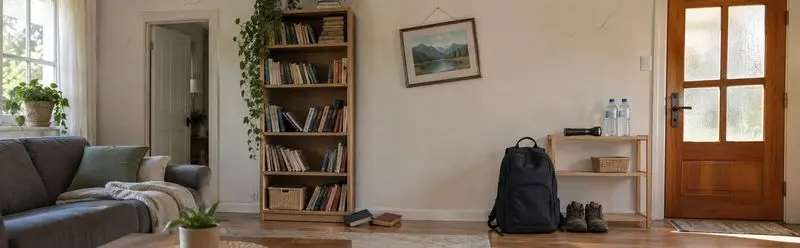
Our suggestion: keep a pair of sturdy shoes and a flashlight where you can reach them from the bed, since three of the pages ask for shoes or a light.
During and after
Ready.gov describes three steps: drop where you are onto hands and knees, cover, and hold on until the shaking stops. After a quake it names leaking gas and water lines and downed power lines as hazards. Italy’s Civil Protection says that before leaving the building you should turn off the gas, water and electricity and put on shoes, and it asks you to learn beforehand where the gas and water taps and the main electricity switch are.
Reviewing the kit
Ready.gov asks you to re-think your needs every year, to update the kit as your family’s needs change, and to replace expired items as needed. For how long food and water last, see do emergency food and water expire.
The part that is different for every home
An apartment on an upper floor and a house with a garden do not need the same things, and it changes again with children, pets or a medicine you cannot miss. For how many days to plan for, see how many days an emergency kit should last. For the water, see how much water per person per day.
Country by country
Each page below is written from that country's own official sources.
Common questions
What should I secure at home before an earthquake?
Ready.gov asks you to secure heavy items such as bookcases, refrigerators, water heaters, televisions and objects that hang on walls, and to store heavy and breakable objects on low shelves. Italy's Civil Protection asks you to move heavy furniture away from beds and sofas, fix tall furniture to the walls, and hang pictures and mirrors with closed hooks.
How many days should an earthquake kit cover?
Ready.gov says several days of food and water. Chile's SENAPRED says basic supplies for 48 to 72 hours. Italy's Civil Protection page lists a first aid kit, a torch and a battery radio, without a number of days.
How much water do the official pages ask for?
They do not agree. Ready.gov says one gallon per person per day for several days, for drinking and sanitation, which is about 3.8 litres. SENAPRED says to consider two litres per person per day. For the reasoning behind a daily amount, see the water article linked below.
Where should the kit be kept?
Ready.gov says to keep it in a designated place, ready in case you have to leave your home quickly. SENAPRED says in an easy-to-reach place, ready to use. Italy's Civil Protection asks you to make sure everyone at home knows where the items are.
What do the official pages say about during and after the shaking?
Ready.gov describes Drop, Cover and Hold On: drop where you are onto hands and knees, cover, and hold on until the shaking stops. Italy's Civil Protection says that before leaving the building you should turn off the gas, water and electricity and put on shoes. Ready.gov names leaking gas and water lines and downed power lines as hazards after a quake.